I have a problem with antibiotic guidelines. Okay, I know that’s a controversial statement for a microbiologist to make given all the efforts that have been put in over the last 15-20 years to try and make antibiotic prescribing better, but let me explain.
Or better yet, let me ask you a question. How do you choose an antibiotic?
Nowadays, when I ask this question, I get a really irritating answer, “I look at the guidelines”.
Or better yet, let me ask you a question. How do you choose an antibiotic?
Nowadays, when I ask this question, I get a really irritating answer, “I look at the guidelines”.
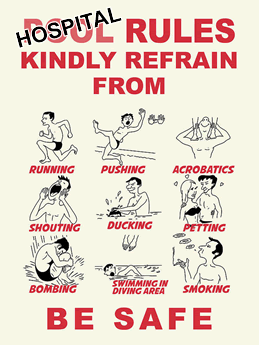
Image: Mark Rogan
So basically, people check their brains at the door and just follow what is written down on a piece of paper or on a computer screen, without even thinking about whether it’s the right thing to do. I also suspect that many people think Microbiologists just pluck the names of antibiotics out of the air when giving advice… the ECIC thinks that stat Gentamicin is the answer to every question!
But in reality, Gentamicin is not the ONLY answer and guidelines may be the WRONG choice; this leads to mistakes being made every day in the choice of antibiotics to treat patients, and most of these are avoidable.
Let me give you some daily scenarios where following a local antibiotic guideline would be the wrong thing to do:
So, how do you avoid making mistakes when choosing what antibiotic to use?
First considerations for prescribing
Before deciding whether to prescribe an antibiotic there are a number of things to consider and questions to ask:
Where do "guidelines" come from?
Empirical antibiotic guidelines are established by answering many of the questions below. It is essential to understand the relevance of these questions and the effect of the answers. Relying on empirical antibiotic guidelines without knowing why or how these guidelines are produced can be dangerous and is poor practice.
Important questions to ask when choosing an antibiotic
I have a specific process I follow when choosing what to prescribe. I have been doing this for so long now that much of this is instinctive or I am able to quickly skip the less relevant questions for a given scenario. BUT when you first start prescribing though it is important to be more careful and consider each question IN TURN, all 15 of them!
1. Does the patient have an infection?
There are many non-infectious reasons for “signs of infections”
2. If the patient has an infection what is the likely source?
3. What are the likely causative microorganisms?
4. Does the patient need an antibiotic or is the infection self-limiting?
5. Does the patient need urgent treatment or is there time to make a diagnosis?
There is often time to make a diagnosis before starting treatment HOWEVER certain infections require immediate management without waiting for investigations as delays can lead to serious and permanent harm to the patient:
6. Is the antibiotic active against the microorganisms?
7. Does the antibiotic get into the site of infection?
8. Does the patient need a bactericidal antibiotic or is bacteriostatic adequate?
9. What route of administration should be used?
10. How much antibiotic should be prescribed?
11. Are there any contraindications or cautions for prescribing this antibiotic?
12. What are the side effects of this antibiotic?
13. When should the patient be reviewed?
14. When can I switch from IV to oral, and how long should I treat the patient for?
15. Do the results of the microbiology investigations identify a specific causative microorganism?
So, there it is. When choosing an antibiotic, I run through 15 questions in this order to choose what the right treatment is. It isn’t easy when you start out with prescribing. Like everything it takes time to learn how to do it properly, but it’s worth it. Patients don’t get better on the wrong antibiotic, and prescribers get in trouble when they mess it up, so it’s in everyone’s interest to get it right first time… so give this method a try… it works for me!
Don’t forget to order your copy of Microbiology Nuts and Bolts; it’s the perfect size for a stocking filler! Yep that’s a desperate plug for Xmas sales to cover the cost of ECIC’s stocking fillers: a tube of orange smarties, drumstick sweets and refreshers :-)
But in reality, Gentamicin is not the ONLY answer and guidelines may be the WRONG choice; this leads to mistakes being made every day in the choice of antibiotics to treat patients, and most of these are avoidable.
Let me give you some daily scenarios where following a local antibiotic guideline would be the wrong thing to do:
- Patient has frequent urinary tract infections with a Gentamicin resistant E. coli but is treated with Gentamicin because that’s what the antibiotic guidelines say to use for pyelonephritis (Hint, those previous urine results would also have said what the E. coli would actually be sensitive to!) The guideline is NOT applicable in this scenario
- Patient has cellulitis following a dog bite but is treated for cellulitis with Flucloxacillin using the generic cellulitis guidelines, but the prescriber should have looked at the infected bites guideline (Hint, bites often involve Gram-negative bacteria and the generic cellulitis guidelines target Gram-positives) The guideline is NOT applicable in the scenario
- Patient has Clostridium difficile and should be receiving oral Vancomycin, but because someone has decided to make them “nil by mouth” the person has prescribed IV Vancomycin instead even though this will NOT cross into the gut to treat the infection (Hint, making a patient “nil by mouth” doesn’t usually stop them receiving their oral medications)
So, how do you avoid making mistakes when choosing what antibiotic to use?
First considerations for prescribing
Before deciding whether to prescribe an antibiotic there are a number of things to consider and questions to ask:
- Make sure you know normal flora and the causes of common infections
- Know your speciality’s serious and common infections, the microorganisms that cause these, and the usual treatments for them
- Use the British National Formulary (BNF) for interactions, cautions and contraindications as well as dosing information
Where do "guidelines" come from?
Empirical antibiotic guidelines are established by answering many of the questions below. It is essential to understand the relevance of these questions and the effect of the answers. Relying on empirical antibiotic guidelines without knowing why or how these guidelines are produced can be dangerous and is poor practice.
Important questions to ask when choosing an antibiotic
I have a specific process I follow when choosing what to prescribe. I have been doing this for so long now that much of this is instinctive or I am able to quickly skip the less relevant questions for a given scenario. BUT when you first start prescribing though it is important to be more careful and consider each question IN TURN, all 15 of them!
1. Does the patient have an infection?
There are many non-infectious reasons for “signs of infections”
- Fever caused by drugs, malignancy, connective tissue disorders
- Increased CRP caused by inflammation, malignancy, connective tissue disorders
- Chest crackles caused by heart failure, pulmonary embolus, fibrosis
- Pyuria (white blood cells in urine) caused by appendicitis, connective tissue disorders, malignancy
2. If the patient has an infection what is the likely source?
- Urine, respiratory tract, skin, bone, joint, heart, CNS etc.…
3. What are the likely causative microorganisms?
- Viruses, bacteria, fungi, parasites
4. Does the patient need an antibiotic or is the infection self-limiting?
- Viral infections are usually self-limiting
- Urethral syndrome and gastroenteritis do not usually require antibiotics
5. Does the patient need urgent treatment or is there time to make a diagnosis?
There is often time to make a diagnosis before starting treatment HOWEVER certain infections require immediate management without waiting for investigations as delays can lead to serious and permanent harm to the patient:
- Sepsis
- Neutropaenic sepsis
- Meningitis
- Meningococcal sepsis
- Encephalitis
- Epiglottitis
- Spinal epidural abscess
- Necrotising fasciitis
- Toxic shock syndrome
6. Is the antibiotic active against the microorganisms?
- See Table of Antibiotic Spectrum of Activity (content from Microbiology N&B)
7. Does the antibiotic get into the site of infection?
- See Table of Penetration, content in Microbiology N&B)
8. Does the patient need a bactericidal antibiotic or is bacteriostatic adequate?
- Immunodeficient patients require bactericidal antibiotics because they are unable to fight infections themselves
9. What route of administration should be used?
- DO NOT use oral antibiotics to treat systemic infections if patients are unable to absorb from the gastrointestinal tract
- Antibiotics with good oral bioavailability rarely need to be given intravenously
10. How much antibiotic should be prescribed?
- Patients in renal failure may need doses of antibiotics reducing
- Patients over 60-70kg may need increased doses of antibiotics as normal doses are calculated for previously normal body size (male of 65kg back in the 1950s!)
11. Are there any contraindications or cautions for prescribing this antibiotic?
- DO NOT use any Beta-lactam antibiotics if the patient has a history of severe penicillin allergy
- Many antibiotics interact with Methotrexate e.g. Trimethoprim, Ciprofloxacin, Doxycycline
- Many antibiotics are contraindicated in myasthenia gravis e.g. macrolides, quinolones, aminoglycosides, Colistin
- Always check the BNF for interactions, cautions and contraindications as well as dosing information
12. What are the side effects of this antibiotic?
- See section Antibiotics, in Microbiology N&B for individual antibiotic agents
- Always check the BNF for side effects
13. When should the patient be reviewed?
- Septic patients should be reviewed within 1 hour of starting treatment
- Daily review of ALL patients on antibiotics
- Don’t forget “stop and review” dates as these help prevent over-treatment and CDAD
14. When can I switch from IV to oral, and how long should I treat the patient for?
15. Do the results of the microbiology investigations identify a specific causative microorganism?
- Once the cause is known, antibiotics should be narrowed down to cover the specific microorganisms identified e.g. CAP caused by Streptococcus pneumoniae can be treated with Penicillin rather than Co-amoxiclav and Clarithromycin
So, there it is. When choosing an antibiotic, I run through 15 questions in this order to choose what the right treatment is. It isn’t easy when you start out with prescribing. Like everything it takes time to learn how to do it properly, but it’s worth it. Patients don’t get better on the wrong antibiotic, and prescribers get in trouble when they mess it up, so it’s in everyone’s interest to get it right first time… so give this method a try… it works for me!
Don’t forget to order your copy of Microbiology Nuts and Bolts; it’s the perfect size for a stocking filler! Yep that’s a desperate plug for Xmas sales to cover the cost of ECIC’s stocking fillers: a tube of orange smarties, drumstick sweets and refreshers :-)









 RSS Feed
