In 1988 the World Health Organisation announced its intention to eradicate polio by 2000. It was a lofty goal but one that was achievable as polio only infects humans, and so if they can stop polio spreading between people then it can be eradicated, and the way to stop spreading polio is to vaccinate against it.
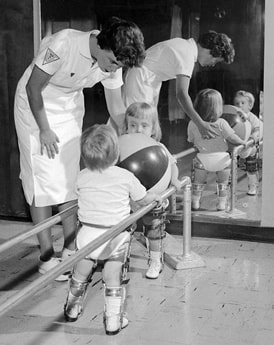
Editor Chief in Charge, in her previous incarnation as a physiotherapist, treated polio patients with calipers like this... yep she's that old... Oi, they were adults who had had it years earlier, not children
The two polio vaccines were developed in 1955 and 1960 in the USA by Jonas Salk and Albert Sabin in what was known as the “March of Dimes” where funds were raised by selling lapel pins for 10 cents each in 1938 in order to develop preventions or treatments for serious public health problems like polio. In that year 2,680,000 dimes or $268,000 were raised. This money was used to fund the development of the vaccines against polio. Polio vaccine is given to children in the UK as part of the primary course of immunisation. Since the vaccines were produced it is estimated they have prevented over 20 million cases of paralysis as a result of polio.
Polio can be a horrible infection causing paralysis of respiratory muscles and long-term neurological damage. Many people are familiar with pictures of the “iron lung” ventilators from the past used to try and keep children with polio alive.
So, the eradication of polio was the aim, and with a few bumps along the way the WHO did appear to be getting somewhere (even if not within the time frame they originally set). The last case of natural polio in the UK was in 1984. In 2019 polio was thought to have been eradicated from everywhere in the World except Pakistan and Afghanistan, from where only 175 cases were reported. We are a long way past the goal of the year 2000, and the new goal is 2026….
But then we had a global pandemic, and Russia’s war on Ukraine, and an energy crisis, and vaccines were no longer able to be moved around the World, and therefore the polio eradication program started to stall….
Heck, then there was even a report on the BBC news this week that 1 million children in London are going to be given booster doses of injectable (non-live) polio vaccine.
Back in May this year the Health Security Agency (HSA) sent an alert to healthcare professionals telling us that there was a possible risk of polio in the UK. This was based on the detection of genetically related Polio Virus isolates in three sewage samples collected from the London Beckton Sewage Treatment Works on the 8th February, 12th April and 26th April 2022. This sewage treatment plant covers a large catchment area across North and East London and a population of about 4 million. Since the beginning of the year the virus has been detected 116 times!
WHAT? IS POLIO BACK?
Before I answer that we need to discuss a little bit about vaccination against polio.
Polio vaccination in the UK
Now if you go back in time, it was very common to detect Polio Virus in sewerage in the UK. This was because we used the oral polio vaccine, known as the Sabin vaccine, a live attenuated virus vaccine which could replicate in the vaccinated person, normally without causing polio, and which then would be excreted in stool for a few weeks. I say normally not causing polio because the attenuated virus can occasionally recombine with other enteroviruses and become capable of causing polio; the incidence of polio after oral vaccination is about 1 in 2 million… much less than the risk of natural polio without any vaccines which causes paralysis in 1 in 100 to 1 in 1,000 unvaccinated people with infection.
The benefits of the oral polio vaccine are it is easy to use, no injections, it is easy to transport and manufacture, it is cheap, and it probably has less requirements to maintain a cold chain in order to vaccinate in remote places AND it came with a sugar lump to eat!!!!
Now eventually polio (and the sugar lump) disappeared from the UK and the risk of polio from the oral vaccine started to outweigh the risk of natural polio. The UK health service therefore decided it was time to move to the safer but more expensive Salk injectable vaccine as this is not a live attenuated vaccine and therefore doesn’t carry the risk of causing polio.
So why is polio back?
Firstly, is the Polio Virus in the sewerage samples from London, wild-type or oral vaccine polio?
Well, the three isolates from this year are all oral vaccine related Polio Virus. The genetic sequencing shows that the isolates are ORAL VACCINE STRAINS that have recombined with another enterovirus AND ALL THREE ISOLATES ARE THE SAME, so they have the same source as in an outbreak. This means there was someone who arrived in London who was excreting live polio virus (having had a recent oral vaccine). As the samples have been collected over a period of time, with the same isolate, there will have been transmission to others in the community in order to allow ongoing excretion into the sewerage system. It is very unlikely that a single person is responsible for all of the isolates over this period of time as the virus in this individual should have been cleared within a few weeks.
So, we have evidence from the stool samples of person-to-person transmission of an oral vaccine related strain of Polio Virus.
What else do we know about this situation?
Because this is an oral polio vaccine strain of virus, we know this is not someone vaccinated in the UK. Note: The UK stopped using oral polio vaccine in 2004 and the oral vaccine related virus is normally only detectable in stool for a few weeks after vaccination. So, as we haven’t used the vaccine for 18 years AND the vaccine virus is only detectable for a few weeks after vaccination the virus has to have come from someone who has recently entered the UK from overseas.
Now trying to find who the person excreting live virus is, is like looking for a needle in a haystack, and ultimately it would be futile. The people affected are going to be asymptomatic (remember vaccine related disease is incredibly rare) and so finding them to offer support and advice is pointless. Not only this but there has been huge amounts of political turmoil over recent years, and we have many refugees in the UK (legal and illegal) who are naturally going to be suspicious of authorities. It is critical that this isn’t seen as a punitive investigation to try and find “a culprit” but seen as a public health investigation to try and make sure we don’t see a re-emergence of polio cases.
Have there been any cases of polio?
So far in the UK there have not been any cases of polio associated with the current situation… and HSA want to keep it that way! However, in the USA there have been cases of polio and one unvaccinated person has been paralysed by the infection.
What is being done?
So, the HSA are going to try and vaccinate 1 million children in London against polio. This may seem like an overreaction given that all children in the UK should already have had their polio immunisation, but the reality is that the vaccine coverage rates aren’t great, on average 15% of children in London haven’t had all of their polio vaccines, and in some areas the rate is as high as 40%. This means there are large numbers of children unprotected against polio and all the other diseases primary vaccination covers. Primary childhood vaccination (injectable vaccine containing non-live Polio Virus) would prevent person-to-person transmission happening as the virus would be eradicated by the body’s immune system before it replicates or causes disease; it cannot be excreted as it is “zapped” before that stage! However with such low rates of vaccine uptake a lot of people are not immune to polio, and hence we have a problem.
So, the plan is to vaccinate all unvaccinated children between 1 and 9 years old in the Greater London area to try and interrupt the spread of the oral vaccine-related polio strain and prevent a possible outbreak of the infection.
Wow! This is a massive undertaking but it is not an overreaction, and I wish them good luck. I for one do not want to see a case of polio, I haven’t seen one yet and I’d really quite like to keep it that way!
Polio can be a horrible infection causing paralysis of respiratory muscles and long-term neurological damage. Many people are familiar with pictures of the “iron lung” ventilators from the past used to try and keep children with polio alive.
So, the eradication of polio was the aim, and with a few bumps along the way the WHO did appear to be getting somewhere (even if not within the time frame they originally set). The last case of natural polio in the UK was in 1984. In 2019 polio was thought to have been eradicated from everywhere in the World except Pakistan and Afghanistan, from where only 175 cases were reported. We are a long way past the goal of the year 2000, and the new goal is 2026….
But then we had a global pandemic, and Russia’s war on Ukraine, and an energy crisis, and vaccines were no longer able to be moved around the World, and therefore the polio eradication program started to stall….
Heck, then there was even a report on the BBC news this week that 1 million children in London are going to be given booster doses of injectable (non-live) polio vaccine.
Back in May this year the Health Security Agency (HSA) sent an alert to healthcare professionals telling us that there was a possible risk of polio in the UK. This was based on the detection of genetically related Polio Virus isolates in three sewage samples collected from the London Beckton Sewage Treatment Works on the 8th February, 12th April and 26th April 2022. This sewage treatment plant covers a large catchment area across North and East London and a population of about 4 million. Since the beginning of the year the virus has been detected 116 times!
WHAT? IS POLIO BACK?
Before I answer that we need to discuss a little bit about vaccination against polio.
Polio vaccination in the UK
Now if you go back in time, it was very common to detect Polio Virus in sewerage in the UK. This was because we used the oral polio vaccine, known as the Sabin vaccine, a live attenuated virus vaccine which could replicate in the vaccinated person, normally without causing polio, and which then would be excreted in stool for a few weeks. I say normally not causing polio because the attenuated virus can occasionally recombine with other enteroviruses and become capable of causing polio; the incidence of polio after oral vaccination is about 1 in 2 million… much less than the risk of natural polio without any vaccines which causes paralysis in 1 in 100 to 1 in 1,000 unvaccinated people with infection.
The benefits of the oral polio vaccine are it is easy to use, no injections, it is easy to transport and manufacture, it is cheap, and it probably has less requirements to maintain a cold chain in order to vaccinate in remote places AND it came with a sugar lump to eat!!!!
Now eventually polio (and the sugar lump) disappeared from the UK and the risk of polio from the oral vaccine started to outweigh the risk of natural polio. The UK health service therefore decided it was time to move to the safer but more expensive Salk injectable vaccine as this is not a live attenuated vaccine and therefore doesn’t carry the risk of causing polio.
So why is polio back?
Firstly, is the Polio Virus in the sewerage samples from London, wild-type or oral vaccine polio?
Well, the three isolates from this year are all oral vaccine related Polio Virus. The genetic sequencing shows that the isolates are ORAL VACCINE STRAINS that have recombined with another enterovirus AND ALL THREE ISOLATES ARE THE SAME, so they have the same source as in an outbreak. This means there was someone who arrived in London who was excreting live polio virus (having had a recent oral vaccine). As the samples have been collected over a period of time, with the same isolate, there will have been transmission to others in the community in order to allow ongoing excretion into the sewerage system. It is very unlikely that a single person is responsible for all of the isolates over this period of time as the virus in this individual should have been cleared within a few weeks.
So, we have evidence from the stool samples of person-to-person transmission of an oral vaccine related strain of Polio Virus.
What else do we know about this situation?
Because this is an oral polio vaccine strain of virus, we know this is not someone vaccinated in the UK. Note: The UK stopped using oral polio vaccine in 2004 and the oral vaccine related virus is normally only detectable in stool for a few weeks after vaccination. So, as we haven’t used the vaccine for 18 years AND the vaccine virus is only detectable for a few weeks after vaccination the virus has to have come from someone who has recently entered the UK from overseas.
Now trying to find who the person excreting live virus is, is like looking for a needle in a haystack, and ultimately it would be futile. The people affected are going to be asymptomatic (remember vaccine related disease is incredibly rare) and so finding them to offer support and advice is pointless. Not only this but there has been huge amounts of political turmoil over recent years, and we have many refugees in the UK (legal and illegal) who are naturally going to be suspicious of authorities. It is critical that this isn’t seen as a punitive investigation to try and find “a culprit” but seen as a public health investigation to try and make sure we don’t see a re-emergence of polio cases.
Have there been any cases of polio?
So far in the UK there have not been any cases of polio associated with the current situation… and HSA want to keep it that way! However, in the USA there have been cases of polio and one unvaccinated person has been paralysed by the infection.
What is being done?
So, the HSA are going to try and vaccinate 1 million children in London against polio. This may seem like an overreaction given that all children in the UK should already have had their polio immunisation, but the reality is that the vaccine coverage rates aren’t great, on average 15% of children in London haven’t had all of their polio vaccines, and in some areas the rate is as high as 40%. This means there are large numbers of children unprotected against polio and all the other diseases primary vaccination covers. Primary childhood vaccination (injectable vaccine containing non-live Polio Virus) would prevent person-to-person transmission happening as the virus would be eradicated by the body’s immune system before it replicates or causes disease; it cannot be excreted as it is “zapped” before that stage! However with such low rates of vaccine uptake a lot of people are not immune to polio, and hence we have a problem.
So, the plan is to vaccinate all unvaccinated children between 1 and 9 years old in the Greater London area to try and interrupt the spread of the oral vaccine-related polio strain and prevent a possible outbreak of the infection.
Wow! This is a massive undertaking but it is not an overreaction, and I wish them good luck. I for one do not want to see a case of polio, I haven’t seen one yet and I’d really quite like to keep it that way!
 RSS Feed
